From
Wikipedia, the free encyclopedia.
Kimono (Japanese:
着物 literally
"something one wears") are the traditional
garments
of Japan.
Originally the word kimono was used for all types of
clothing, but it came to refer specifically to the full-length
garment that is still worn by women, men, and children.
Kimono are T-shaped,
straight-lined robes that fall to the ankle, with collars and
full-length sleeves. The sleeves are commonly very wide at the
wrist, perhaps a half meter. Traditionally, unmarried women
wear kimono with extremely long sleeves that extend almost to
the floor. The robe is wrapped around the body, always with
the left side over the right, and secured by a wide belt
tied in the back, called an obi.
The modern kimono began
to take shape in the Heian
period (CE 794–1192).
Since then the basic shape of both men's and women's kimono
has remained essentially unchanged.
Traditionally, all
women's kimono were basically one size. Tucks and folds in the
fabric accommodated different body heights and shapes. Kimono
were made from a single bolt of kimono fabric. The bolts came
in standard dimensions, and all the fabric was used in the
making of the kimono. All traditional kimono are sewn by hand,
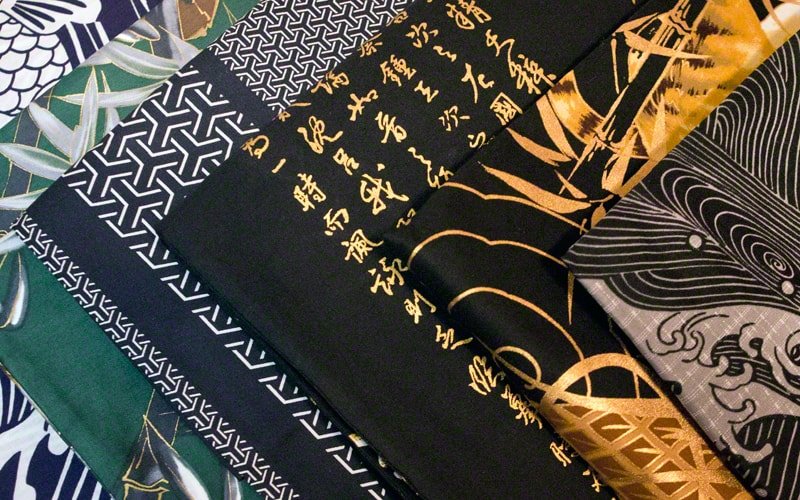
and the fabrics from which they are created are also
frequently hand made and hand decorated. Various techniques
such as yuzen
dye resist (made with a rice paste), shibori,
as well as hand-painting are incorporated into the kimono
which governs where the pattern is distributed and if it is a
singular or a repeating pattern. Repeating patterns that cover
a large section of the kimono are traditionally done with the yuzen
resist technique and a stencil.
In the past, a kimono
would often be entirely taken apart for washing, and then
re-sewn for wearing. Modern fabrics and cleaning methods have
largely eliminated this practice. "Basting
stitches"—long, loose stitches—are sometimes placed
around the outside edges of the kimono for storage. They help
to prevent bunching, folding and wrinkling, and keep the
kimono's layers in alignment.
Over time there have
been many variations in colour, fabric and style, as well as
accessories such as the obi.
There are styles of
kimono for various occasions, ranging from extremely formal to
very casual. The level of formality of women's kimono is
determined by the shape (mostly the length of the sleeves),
pattern and fabric, and also the colour. Men's kimono are
usually one basic shape and are mainly worn in subdued colours.
Formality is determined by the type and colour of accessories,
the fabric,
and the number or absence of mon
(family crests). Silk
is the most desirable, and most formal, fabric. Cotton
is more casual. These days there are polyester
kimono as well; they are generally more casual.
Yukata (Japanese:
浴衣)
is a type of clothing
worn by the Japanese,
especially women, at firework
festivals and other summer events. It is a kind of casual kimono,
also commonly worn after the bath at Japanese-style hotels. The
word literally means bath robe or bath clothing.
A yukata is a cooling
garment to wear. It consists of one big piece of cloth with two
wide sleeves. It's not always obvious how to wear a yukata
properly. An obi
(belt) is used to keep the yukata from falling open. Also, a
special type of sandal, geta,
which only has one strap, is worn with the yukata.
Traditionally yukata were
mostly made of blue-printed cotton but today there is a wide
variety of colors and designs. Many young women wear yukata
today, arranging them in various ways.
Amongst
men, the most common use of yukata in public is when it is worn
by sumo
wrestlers. Junior ranked sumo wrestlers are expected to wear
yukata when out in public, irrespective of the weather
conditions or time of year. During the summer all wrestlers tend
to wear this attire.
Both men and women often
wear Yukata at traditional Japanese hotels, especially those
with their own onsen. After checking in, people get changed into
the yukata provided by the hotel and then go for a walk outside,
to the public baths and also dinner and breakfast wearing their
yukata.
Two ladies in summer
yukata from the back, showing the obi and fan, in Tokyo, Japan.